
By: Vincent J. Straub, Nadia V. Harerimana, Lyydia I. A. Alajääskö
All views expressed are those of the authors.
In our recent Nature Human Behaviour Comment, “Early career researcher-led best practices for social science and behavioural genetics”, we, together with co-authors Sergio Ordonez Beltran, Asya Bülbül, Tomeu López-Nieto Veitch, Qiyuan Peng, Rossella De Sabbata, and Mar Talens, argue that social science and behavioural genetics (SBG) is at a critical juncture and advocate for unified best practices.
As early-career researchers, we write in response to increasing concerns regarding the misuse of genetic research, the rise of commercial embryo selection for IQ and educational attainment, and renewed interest in race-based genetic analyses. We are particularly concerned by increasing warnings from geneticists about “race science” and documented instances where genetic research has been misappropriated to justify racist ideology.
We write at a moment of rapid expansion in SBG, as polygenic indices (PGIs) and genome-wide association studies (GWAS) have gained prominence both within and beyond academic circles. Figure 1 illustrates the rapid increase in the use of terms such as “GWAS” and “polygenic indices” in scientific literature over the past decade (a), alongside a broader resurgence of genetic and eugenics-related language in public discourse (b). In parallel, direct-to-consumer companies are increasingly marketing polygenic embryo screening for behavioural and socioeconomic traits, despite persistent ethical and validity concerns.
Importantly, the field increasingly demonstrates a dynamic interplay between genetic variation and social environments: genetic differences are associated with social outcomes, while social structures influence patterns of genetic transmission across generations. Consequently, SBG findings should be situated within their broader social and historical contexts.
PGIs are statistical constructs that capture only a portion of heritable variation and are highly context-dependent. As such, findings are susceptible to misinterpretation, particularly when complex statistical associations are presented deterministically. Imprecise language and deterministic framing open the door to genetic essentialism and reductionist narratives. The absence of validity standards for PGI applications beyond research enables commercial overreach, and without early community consultation, public trust is already being eroded.
In the Comment, we present recommendations designed to address these risks, including clearer communication of the predictive limitations of PGIs, increased use of family-based research designs, more intersectional measurement of social inequalities, and deeper engagement with affected communities.
One issue we could not fully explore in the Comment, but feel strongly about, is the role that language itself plays in shaping how genetic research is understood. Terms like “genetic endowment” or “genetic potential” are not neutral descriptors, they carry interpretive weight. In Box 1 below, we reflect on how such terminology in SBG can unintentionally reinforce deterministic interpretations of behavioural and socioeconomic outcomes, and encourage researchers to favour terms like “genetic correlates” or “genetic associations” that better capture the probabilistic, context-dependent nature of these findings.
Maintaining public trust in SBG will require more than methodological innovation. As publicly funded scientists in a field with direct historical ties to eugenics, acknowledging that history is a starting point; the greater obligation is to build standards that prevent future harms. That means clearer participatory ethics, transparent communication, and sustained investment in diversity, equity, and inclusion across both datasets and research environments.
You can read the article here.
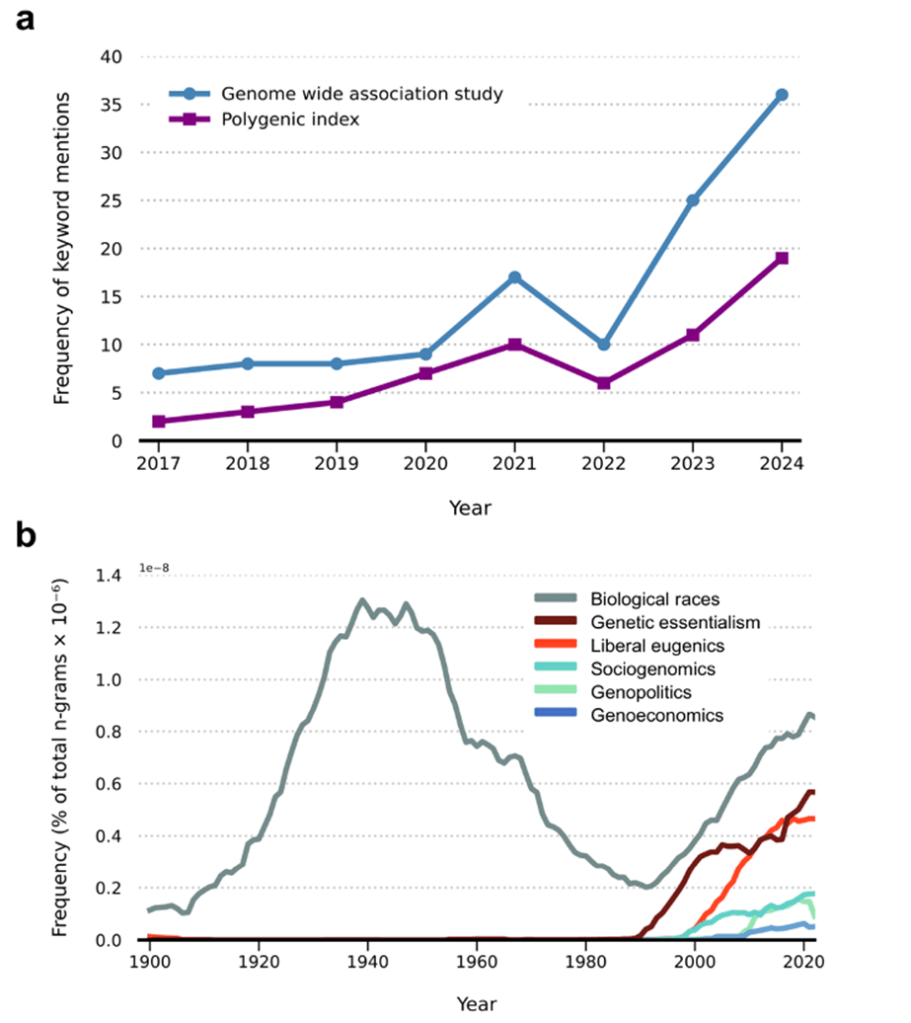
Figure 1: Trends in the use of genetic terminology in scientific and public discourse.
(a) Annual count of Nature Human Behaviour articles mentioning GWAS and PGI from 2017 to 2024, showing continued growth in usage with a temporary decline during the COVID-19 pandemic. (b) Relative frequency of selected terms related to social science, genetics, and historical eugenics in the Google Books English corpus (1900–2022). Recent increases in terms such as sociogenomics, genopolitics, and genoeconomics occur alongside a broader resurgence of discourse involving genetic and eugenics-related language.
Box 1: How language shapes understanding in social science genetics
The words used to describe SSG research shape academic interpretation, public understanding, policy uptake, and the ethical framing of findings. Researchers have a responsibility to communicate complexity without reinforcing genetic determinism, essentialism, or reductionism (Harden 2023).
We provide OED definitions for terms commonly used in SSG to discuss PGIs for behavioural traits and socioeconomic outcomes. We highlight concerns with each and offer our own recommendation:
Endowment: A ‘gift’, power, capacity, or other advantage with which a person is endowed by nature or fortune.
Concern: ‘Genetic endowment’ can imply a static allotment of worth or ability, reinforcing essentialist interpretations of achievement.
Liability: An attribute or trait which sets one at a disadvantage; hence, a burdensome or disadvantageous person or thing, a handicap.
Concern: The term ‘genetic liability’ may suggest an innate burden or flaw, reinforcing deterministic assumptions.
Potential: Possible as opposed to actual; having or showing the capacity to develop into something in the future; latent; prospective.
Concern: In social science contexts, invoking “potential” can be problematic: it suggests a fixed innate ceiling for achievement or ability, echoing genetic essentialism.
Predisposition: The condition of being predisposed or inclined beforehand (to do something, or to a particular opinion, course of action, etc.); a prior inclination or pre-existing tendency.
Concern: For behavioural or socioeconomic outcomes, invoking a “predisposition” risks oversimplification, as it can suggest a built-in destiny, downplaying environmental influence and reinforcing essentialism.
Propensity: Essentially synonymous with predisposition—it denotes an inclination to, towards, or for a particular action, habit, quality, etc.; a tendency to do something.
Concern: Although somewhat probabilistic, it may be misread as an innate push toward a trait, inviting reductionist readings.
Susceptibility: Essentially synonymous with predisposition – it denotes an inherited sensitivity to developing a trait given a certain genetic variant.
Concern: Implies passive ‘vulnerability’ and risks deterministic interpretations, especially if environmental context is ignored.
Tendency: The fact or quality of tending to something; a constant disposition to move or act in some direction or toward some point, end, or purpose.
Concern: May imply traits (e.g., low income) are constant and naturally programmed, encouraging reductionist views unless explicitly framed as probabilistic.
Risk: (Exposure to) the possibility of loss, injury, or other adverse or unwelcome circumstance.
Concern: While a standard term in medical settings, it brings clinical overtones and can foster stigma or fatalism if misinterpreted as fate in social science studies.
Recommendation: We encourage researchers to use the terms “genetic correlates” and “genetic associations” to describe how PGIs relate to the probability of expressing behavioural traits or experiencing socioeconomic outcomes. This emphasizes their probabilistic, non-deterministic nature and minimises the risk of genetic determinism, essentialism or reductionism.
This research was supported by the European Social Science Genetics Network (ESSGN) under the European Union’s Horizon 2020 research and innovation programme’s Marie Skłodowska-Curie grant agreement (ESSGN 101073237). The views expressed in this publication are those of the authors and do not necessarily reflect those of the European Union, MSCA Horizon Europe, or ESSGN. Neither the European Union, nor the granting authority or ESSGN can be held responsible for them.

